AI in the Creative Industries: Opportunity, Risk and Responsibility
Updated: Jun 12

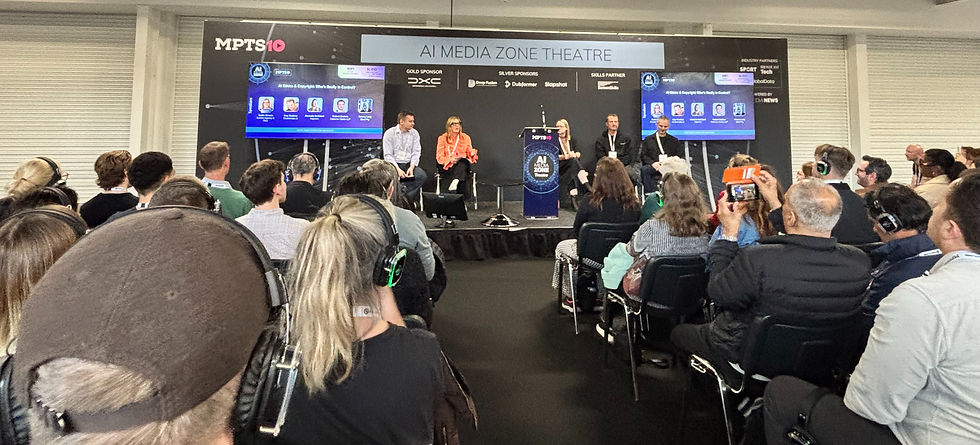
I had the pleasure of attending the Media Production and Technology show MPTS26 on 12th - 13th May in London Olympia. My main aim was to find out as much as I could about how AI is being used in the industry. Here are my key take outs from the two days of talks and panels that I attended at the AI media zone theatre.
Across the two days of discussions a consistent picture emerged of an industry in transition: energised by the creative possibilities of AI, yet still grappling with its ethical, legal and practical implications. Rather than a single narrative, what unfolded was a layered exploration of how artificial intelligence is reshaping content production, from pitching and previsualisation through to distribution, authorship and audience trust.
A shifting creative landscape
One of the clearest themes was that AI is not simply another production tool, but a structural shift in how media is made. It is changing who can create content, how quickly ideas can be tested, and how cheaply formats can be prototyped. The result is a more accessible and iterative creative environment, where small teams, sometimes operating like fully-fledged agencies can develop, visualise and pitch ideas at unprecedented speed.
This has already begun to affect commissioning practices. AI-assisted pitching is becoming more common, with teams using generative tools to create visuals, mock-ups and even voiceovers to strengthen proposals. These outputs are rarely final, but they help ideas stand out in competitive commissioning environments. At the same time, AI is being used in production workflows to accelerate processes such as editing, sound design and visual effects, even if traditional craft skills remain essential to achieve broadcast-quality results.
However, this acceleration comes with an important caveat: AI is not a press the button and it's done solution. Multiple speakers emphasised that meaningful outputs still require expertise, judgement and taste. In many cases, AI produces a wide range of possibilities, but only a small proportion are usable without significant human refinement. As one speaker suggested, AI raises the ceiling of ambition rather than removing the need for craft.
Human creativity at the centre
Despite concerns about automation, the dominant view was that human creativity remains central. Whether in scripting, directing, editing or performance, AI currently struggles with nuance, particularly in areas such as humour, emotional timing and musicality. In practice, this means AI often delivers rough material that must be shaped, edited and refined by experienced practitioners.
New hybrid roles are already emerging. Editors, for example, are on occasion acting as both creatives and prompters, guiding AI systems while maintaining narrative coherence. Similarly, creative directors are learning to communicate with AI tools effectively, providing clear goals and context to achieve desired outcomes. These skills such as prompting, experimentation and context management are becoming part of the core creative toolkit.
At the same time, there is growing concern about skills atrophy, the risk that over-reliance on AI could weaken fundamental craft skills. The consensus across sessions was that a hybrid approach is essential using AI to enhance, rather than replace, human capability.

Ethics, copyright and ownership
Alongside creative opportunity, the talks repeatedly returned to questions of ethics and legality. Current copyright frameworks remain unsettled, particularly around training data, authorship and ownership of AI-generated outputs. High-profile legal cases illustrate the difficulty of enforcing rights, and many speakers noted that content creators are not yet fully protected.
This uncertainty has led to a strong emphasis on the chain of title, ensuring that rights are properly cleared and documented throughout production. Organisations are increasingly implementing guardrails, such as restricting the use of unlicensed tools, avoiding copyrighted inputs, and maintaining detailed records of prompts and outputs.
Some companies are going further, embedding ethical frameworks directly into their processes. This includes hiring digital ethicists, conducting consequence scanning to assess potential harms, and communicating transparently with clients and collaborators about how AI is used. In sensitive contexts such as factual programming involving vulnerable contributors, AI is being used to anonymise identities, enabling stories to be told that might otherwise remain inaccessible.
At a broader level, there is growing recognition that new economic models may be needed. Many speakers pointed to the likelihood that systems for compensating creators will become increasingly important as AI reshapes how content is generated and distributed.
Trust, transparency and audience expectations
If there was one unifying theme across both days, it was the importance of trust. As AI-generated content becomes more widespread, audiences are increasingly asking: what is real and what is synthetic?
This has implications for how content is made and presented. Some speakers argued that transparency should be built into the production process itself, with creators showing their working and clearly signalling the role of AI. Others suggested that the real differentiator may be human content, foregrounding the presence of real people, voices and creative decisions in an increasingly synthetic landscape.
For broadcasters, this represents a shift in how relationships with audiences are built. Rather than producing content in isolation and releasing it to the public, there is a growing emphasis on visible development processes. In a world of abundant content, trust and authenticity may become the primary markers of value.

Responsible adoption and emerging practices
Day two shone a light on how AI is being integrated into professional workflows. A consistent message was that responsible use requires clear governance structures, ongoing training and a willingness to experiment critically. Many organisations are running regular internal training sessions, ensuring that teams stay up to date with rapidly evolving tools and capabilities.
Tool selection itself has become a strategic decision, often shaped by legal and reputational considerations. Some platforms are avoided entirely due to concerns about training data, while others are favoured for their compliance frameworks and licensing models. This reflects a broader shift towards AI tools designed to operate within professional and legal boundaries.
At the same time, new forms of creative practice are emerging. AI-native workflows, synthetic talent, and fully or partially AI-generated productions are beginning to appear at scale, with some projects already in development for release in the coming years. These developments are not replacing traditional methods entirely, but they are expanding the range of what is possible.
Environmental considerations
A more critical perspective emerged in discussions around sustainability. While AI can improve efficiency in some areas, its environmental impact remains difficult to measure due to limited transparency around energy use. This creates a responsibility gap, where organisations are expected to act sustainably without access to reliable data.
In the absence of strong regulatory frameworks, responsibility is falling largely on producers and creatives to self-regulate. This includes developing internal guidelines, improving climate literacy within teams, and assessing the environmental impact of different tools and workflows. As with other aspects of AI adoption, the challenge lies in balancing innovation with accountability.

Looking ahead
Taken together, the talks suggest that AI is neither a simple threat nor a simple solution. It is a powerful, evolving set of technologies that can expand creative possibility, reduce financial barriers and enable new kinds of storytelling, but only when used thoughtfully and responsibly.
The most successful approaches appear to share several characteristics: a commitment to human-centred practice, strong ethical and legal frameworks, ongoing experimentation, and a willingness to engage critically with both the opportunities and risks. Across all discussions, one message stood out: AI works best not as a replacement for human creativity, but as a collaborator. One that amplifies, challenges and extends what creators can do.
As the industry continues to adapt, the key questions are likely to shift from What can AI do? to a) What should we do with AI? and b) How do we do it responsibly? In that sense, the future of AI in the creative industries will be shaped not just by technological capability, but by the decisions, values and practices of those who use it.


Comments